Welding · Buying guide
Choosing a TIG Welder: An Audit of the Specs That Matter
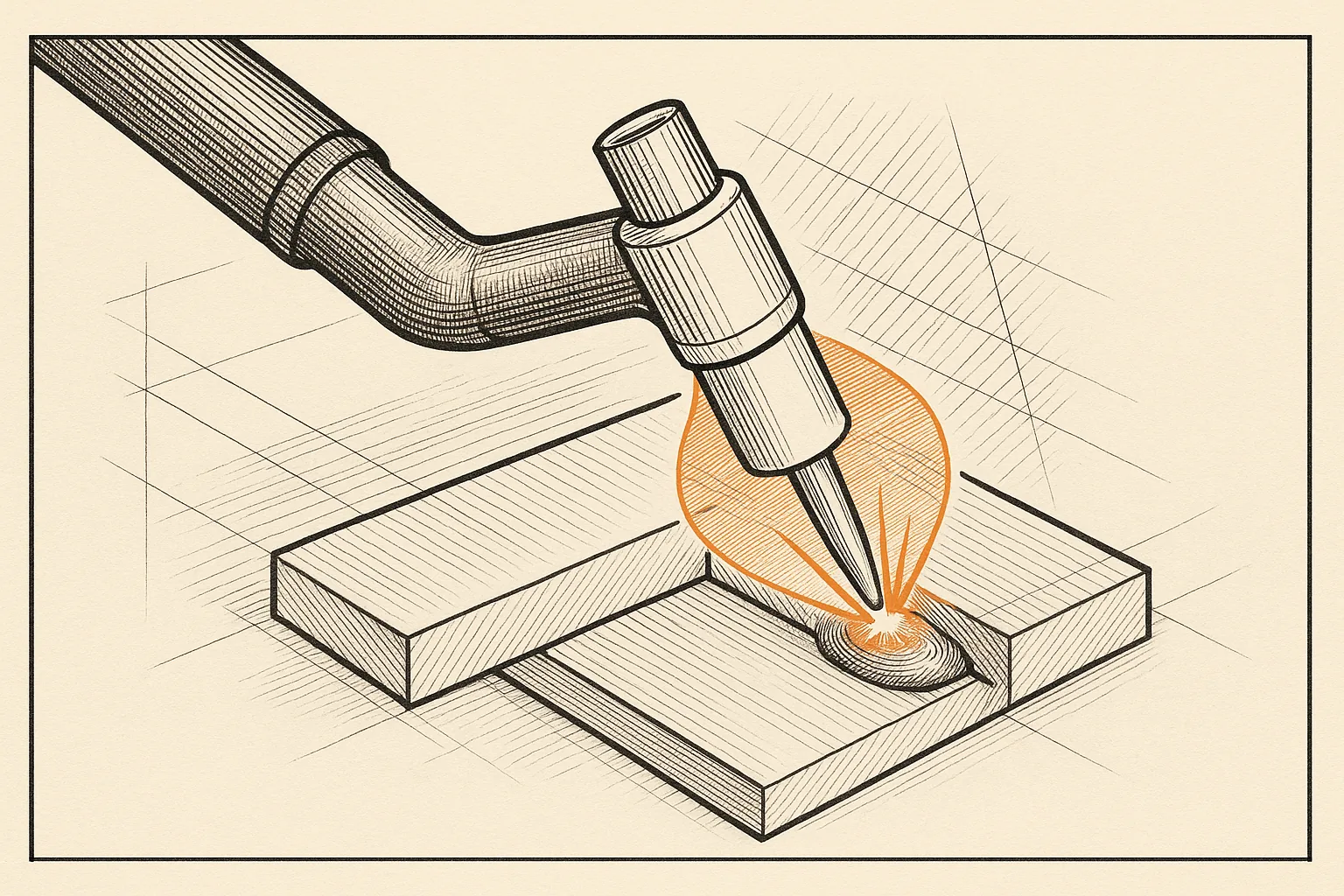
The aluminum gate has cracked where it always cracks: the weld at the hinge-side corner, the joint that carries the frame's whole weight every time it swings. It is a small repair with one big requirement — the metal is aluminum — and that single fact sorts the entire TIG market into two piles before price enters the conversation.
We have not welded that gate, and this page will not pretend otherwise. There is no test lab here. What follows is an audit of the published record — manufacturer spec sheets, the IEC and OSHA rule text, and settings guidance from named trade sources — laid out so you can read a TIG spec sheet the way the people who wrote it do. Every load-bearing number carries a marker keyed to the sources ledger at the foot of the page.
The decision#
The fork that decides the purchase: will this machine ever touch aluminum? Welding aluminum properly demands AC output — the electrode-positive half of the AC cycle is what breaks up aluminum's oxide layer, and a DC-only TIG machine cannot do it Spec[1]. Answer that question first; it removes half the market either way. Then, by reader:
- First-house DIYer. If the job list includes aluminum — gates, patio furniture, trailer pieces — only AC/DC machines are candidates[1]. The downside is real: AC/DC machines cost more than DC-only ones of the same amperage, and you will be paying for balance and frequency controls before you know how to use them.
- Apprentice. Long practice sessions make duty cycle — how many minutes in ten the machine can actually weld at a given amperage[2] — matter more than headline maximum amps. The downside of buying for duty cycle: it is the least advertised number on the sheet and you have to dig for it.
- Small contractor. The binding number is duty cycle at your working amperage, read as a pair — "200 A" means little until the percentage beside it says how long the machine holds it[2][3]. Downside of the old transformer machines that fill the secondhand market: they are heavy, hard to move, and draw more input power for the same output[5].
- Homesteader. Steel repairs dominate homestead work, and DC-only covers steel and stainless; buy AC/DC only if aluminum is genuinely on the list[1]. Downside either way: TIG is a line-powered process — the arithmetic in the reasoning section shows why no battery platform rescues it — so the machine lives where the power is.
- Renter. One cracked gate does not justify a machine. Price a local fabrication shop against the cheapest honest AC/DC unit before buying; the machine only wins if there is a second and third job behind this one. Downside of waiting: none that the evidence shows.
There is no "best TIG welder." There is a machine whose output type matches your metals, whose amperage matches your material thickness, and whose duty cycle matches how long you weld between breaks. The rest of this page is how to read those three off a spec sheet.
The evidence table: the spec sheet, decoded#
| Spec on the sheet | What it actually tells you | Source |
|---|---|---|
| AC/DC vs DC-only | AC is the aluminum gate: the electrode-positive half-cycle breaks up the oxide layer. DC-only means steel and stainless, not aluminum. | The Fabricator [1] |
| Maximum amperage | Rule of thumb for aluminum: ~1 A per 0.001 in. of thickness — about 125 A for 1/8 in. is the source's own example — deviating above 1/4 in., where proportionally less is needed: 3/8 in. material welds from a 280 A power source. | The Fabricator [1] |
| Duty cycle | Percentage of a 10-minute period the machine can weld at the stated amperage, at 40 °C, before thermal cutout, under IEC 60974-1. Meaningless without the amperage printed beside it. | Weldguru [2]; Jasic [3]; Weldclass [4] |
| AC balance | The electrode-negative/positive mix: ~67–75% electrode-negative suits clean, new aluminum (penetration); more electrode-positive adds cleaning action for oxidized metal. | Welding Tips and Tricks [6]; The Fabricator [1] |
| AC frequency | Arc shape: higher (150–250 Hz) gives a focused arc for thin material, tight fillets and precision work; lower (40–80 Hz) a softer, wider arc for build-up and thicker plate; 100–120 Hz is the general-purpose band. | THG Automation [7] |
| Shielding gas flow | Argon flow follows cup size — the rule of thumb is 2–3 CFH per cup-size number, which puts the common #7 cup at 14–21 CFH — and it is a recurring cost the spec sheet never mentions. | Weldmonger / Jody Collier [10] |
60% @ 200 A = 6 MIN WELDING / 4 MIN COOLING, PER 10, AT 40 °C Definition per IEC 60974-1, as explained by Weldguru [2], Jasic [3], Weldclass [4]
The reasoning: the arithmetic, shown#
Thickness to amperage. Apply the Fabricator's aluminum rule of ~1 A per 0.001 in.[1] and the working range writes itself Inference: 1/16 in. (0.063 in.) is about 63 A, 1/8 in. (0.125 in.) about 125 A — the source's own worked example[1] — 3/16 in. (0.188 in.) about 190 A, and 1/4 in. (0.250 in.) about 250 A. Above 1/4 in. the linear rule deviates and proportionally less is needed; the source's example there is 3/8 in. material welded from a 280 A power source[1]. This is why 200 A is the usual ceiling spec for hobbyist machines: by the rule it covers aluminum to about 0.200 in. — 3/16 in. with margin to spare — which covers gates, brackets, and most repair work.
Why duty cycle collapses as amps rise. Higher amperage generates more heat inside the machine, and duty cycle falls as amperage climbs[2]; the arithmetic reason Inference is that resistive heating scales with the square of the current (I²R), which is why the fall-off is steep — the same machine that runs 60% at 200 A holds a much lower percentage near its maximum. Read as a worked example Inference: a "60% at 200 A" rating means six minutes of welding and four minutes of waiting in every ten[2][3] — fine for repair work with repositioning between beads, limiting for long production runs. Two machines both advertised as "200 A" can be honest and still be very different tools if one holds that output three times as long.
Inverter vs transformer. The trade is documented in Weldguru's side-by-side of the two architectures[5]: transformer machines are bulky, heavy and hard to move, and they waste more of what comes out of the wall — an inverter can deliver the same output on up to 50% less input power[5]. Inverters are also what put AC balance and AC frequency adjustment on the front panel at all: an inverter can shape its AC output into square, triangular and soft waveforms, where a transformer is limited to a simple sine wave[5]. The honest counterpoint from the same source: transformers last, and decades-old transformer units remain in service in numbers no inverter generation has yet had time to match[5]. For a garage buyer the fork usually resolves itself: portability and controls beat the longevity of a machine you cannot lift.
Why there is no cordless TIG in this audit. Run the current figures against any battery pack Inference: even at an implausibly low 10 volts across the arc, 200 A is 2,000 watts — kilowatt-class sustained draw for minutes at a time, per the duty cycle definition above[2]. TIG is a corded process. Plan the machine around the outlet, not the other way around.
The safety file#
The base standard for the work itself is Standard ANSI Z49.1, Safety in Welding, Cutting, and Allied Processes, published by the American Welding Society; OSHA's welding rule for general industry, 29 CFR 1910.252, incorporates the 1967 edition of it[8].
The number most buyers get wrong is the lens shade. OSHA's eye-protection rule, 29 CFR 1910.133, sets the legal floor: its filter-lens table puts gas tungsten arc welding (TIG) at 50–150 A at shade 8 minimum, and from 150 to 500 A at shade 10 minimum[11]. The AWS Welding Digest shade chart recommends darker than the floor — shade 10–12 at 50–150 A and 12–14 above 150 A[9] — which means the aluminum amperages in the table above, near 1/4 in. thickness, sit at shade 10 minimum by rule and shade 12-plus by the AWS recommendation. The protective eyewear itself must comply with ANSI Z87.1, named in the same rule[11].
50–150 A: SHADE 8 MINIMUM · 150–500 A: SHADE 10 MINIMUM OSHA 29 CFR 1910.133(a)(5) filter-lens table [11]; AWS Welding Digest recommends darker: 10–12 / 12–14 [9]
A shade number is a standard, not a preference, and it is the one spec on this page where "close enough" is the wrong answer.
What breaks#
- Thermal cutout mid-bead. Exceed the duty cycle and the machine's thermal protection shuts the arc down until it cools — that is the IEC 60974-1 rating working as designed, and the spec sheet was the warning[2][3]. Chronic cutouts mean the machine was bought one size too small for the work, not that it is defective.
- Aluminum welds that will not clean up on DC. Without the electrode-positive half-cycle of AC output there is nothing breaking up aluminum's oxide layer, which is why a DC-only machine cannot weld aluminum properly no matter the filler or the operator[1]. This failure is bought at the checkout, not made at the bench.
- Dirty, oxidized metal welded on clean-metal settings. The ~67–75% electrode-negative balance that suits new aluminum is not the setting for weathered or oxidized stock, which needs more electrode-positive cleaning action[6][1] — a repair-work detail that matters precisely for jobs like an old gate frame.
- Eyes. TIG above 150 A behind a shade lighter than 10 is outside what the OSHA filter-lens table permits[11], and the AWS chart recommends darker still[9]. The standard exists because the injury is well documented; buy the helmet to the chart, not to the price tag.
What the evidence doesn't cover#
Owning the gap is the policy here, so plainly: we could not find a public, instrumented, cross-brand laboratory comparison of budget TIG welders. The independent testers this site cites in other categories have not, as far as our search found, published one for this category. That means:
- Duty-cycle figures on spec sheets are manufacturer self-declarations against the IEC 60974-1 method[2]; we found no independent verification of them for budget-brand machines.
- The inverter-vs-transformer comparison rests on a welding-publication explainer[5], not on instrumented efficiency measurements of specific machines — useful for the shape of the trade, not as certified test data.
- Nothing on this page tells you how any specific machine holds up over years, because no source we consider citable has published that data.
This is why the guide audits specs rather than ranking models: the specs are published and checkable; the rankings would be invented.
Sources ledger#
- The Fabricator, "Aluminum TIG welding settings: what you need to know" — AC polarity and the oxide layer; the ~1 A per 0.001 in. rule, its 125 A-for-1/8 in. example, its deviation above 1/4 in. and the 3/8 in.-on-280 A example; balance-control guidance (modern factory preset ~75% electrode-negative).
- Weldguru, "Duty cycle in welding" — the duty-cycle definition (10-minute period, rated at 40 °C per the 60974-1 test method) and that higher amperage generates more heat and reduces duty cycle.
- Jasic UK, "What is a welding duty cycle" — duty cycle read as minutes welding versus cooling per EN 60974-1's 10-minute period, rated to +40 °C ambient.
- Weldclass, "Welding machines: what is duty cycle and how is it calculated" — duty-cycle calculation in a 40 °C test chamber and reading amps and percentage together.
- Weldguru, "Inverter vs transformer welders: differences explained" — inverter efficiency (same output on up to 50% less input power), weight and portability contrast, waveform control (transformers limited to a sine wave), and transformer longevity as the counterpoint.
- Welding Tips and Tricks, "TIG welder settings" — AC balance around 67–75% electrode-negative for clean new aluminum; more electrode-positive for corroded stock.
- THG Automation, "TIG welding aluminum settings" — AC frequency bands: 150–250 Hz for thin material and precision work, 100–120 Hz general purpose, 40–80 Hz for wide beads and build-up on thicker plate.
- OSHA, 29 CFR 1910.252, "Welding, cutting, and brazing — general requirements" — the general-industry welding rule; references ANSI Z49.1 (1967 edition), Safety in Welding, Cutting, and Allied Processes.
- AWS Welding Digest, "Complete welding lens shade chart: safety guide for eye protection" (Nov 2025) — recommended GTAW shades by amperage: 10–12 at 50–150 A, 12–14 above 150 A.
- Weldmonger (Jody Collier / Welding Tips and Tricks), "How to TIG weld: a one-page guide — simple rules of thumb" — argon flow rule of thumb of 2–3 CFH per cup-size number; #7 cup at 14–21 CFH for steels and aluminum.
- OSHA, 29 CFR 1910.133, "Personal protective equipment — eye and face protection" — the filter-lens table: GTAW minimum shade 8 below 150 A, shade 10 at 150–500 A; eye protection to ANSI Z87.1 per 1910.133(b)(1).
Change notes#
Cite this page: Precious Handyman, "Choosing a TIG Welder: An Audit of the Specs That Matter," updated 2026-08-05, https://precioushandyman.com/best-tig-welder/