Power tools · Buying guide
Brushless vs Brushed: What the Premium Actually Buys
The deck has worked itself loose the way decks do — a few hundred screws backed out an eighth of a turn each, a full weekend of driving ahead of you. At the store, two drills from the same brand sit on the same shelf, in the same voltage class, with the same chuck. One box says brushless and costs $60 more. The word is printed like it settles something.
This page audits what that word is actually worth. We have not torn down either motor, and there is no test lab here. What follows is the published record — engineering references on how the two motor types work and wear, the manufacturers' own spec pages and claims, and a same-brand catalog price pair — laid out so you can decide whether the premium is buying you anything your work will ever collect on. Every load-bearing number carries a marker keyed to the sources ledger at the foot of the page.
The decision#
The fork that decides the purchase: how many hours will this tool actually run, and what does a failure cost you when it happens? A brushed motor's wear item is its brushes — consumables that ride the spinning commutator and wear down[1][2]. An infrequent user may never reach that wear-out; Bob Vila's guide puts it plainly: occasional DIY users "might never wear out a set of brushes"[4]. Multiply your use frequency by your cost of failure, and the answer usually writes itself. By reader:
- First-house DIYer. A drill that runs half an hour a week takes over a century to reach the ~3,000-hour brushed service-life figure in the engineering literature (arithmetic below)[1]. Brushed is the rational buy at this frequency; the published gap that still favors brushless for you is per-charge runtime, not lifespan[4]. Downside of brushed: the tools are increasingly the bottom of each maker's line, so you often give up torque and features along with the motor type[5][6].
- Apprentice. Daily hours change the arithmetic — at two hours a day the brushed wear figure arrives in about six working years, the brushless figure not for twenty-plus (arithmetic below)[1], and a tool that dies mid-task on a job site costs more than its price. Downside of brushless: the premium lands exactly when your budget is thinnest, and no independent test we could find verifies the makers' lifespan multipliers (the gaps box).
- Small contractor. Your failure cost is billable time, and the brushless maintenance case — no brushes to inspect or replace[1] — reads as fewer interruptions. Downside: the flagship brushless claims ("up to 10X longer motor life") are printed without a stated baseline or test method[8]; buy on the engineering direction, not the multiplier.
- Homesteader. Runtime per charge is your number — a brushless drill "might run anywhere from 30 to 50 percent longer" per charge than the same drill brushed[4], and charging opportunities are what a long fence line lacks. Downside: the figure is a generalist's range, not a measured result for any specific pair; batteries you already own may matter more than the motor (see the battery-platform audit).
- Renter. Hanging shelves and assembling furniture will not wear out brushes in your lifetime[4]. Buy the cheapest honest drill from a platform you might grow into, and spend the $60 difference on bits and anchors. Downside: if you later inherit a house's worth of projects, you may buy twice — that is the bet, stated.
There is no "brushless is better," full stop. There is an engineering direction that genuinely favors brushless — less friction, less heat, no consumable contact parts[1][2][3] — and a price sheet that charges you for it whether or not your hours will ever cash it in.
The mechanism: what the word means#
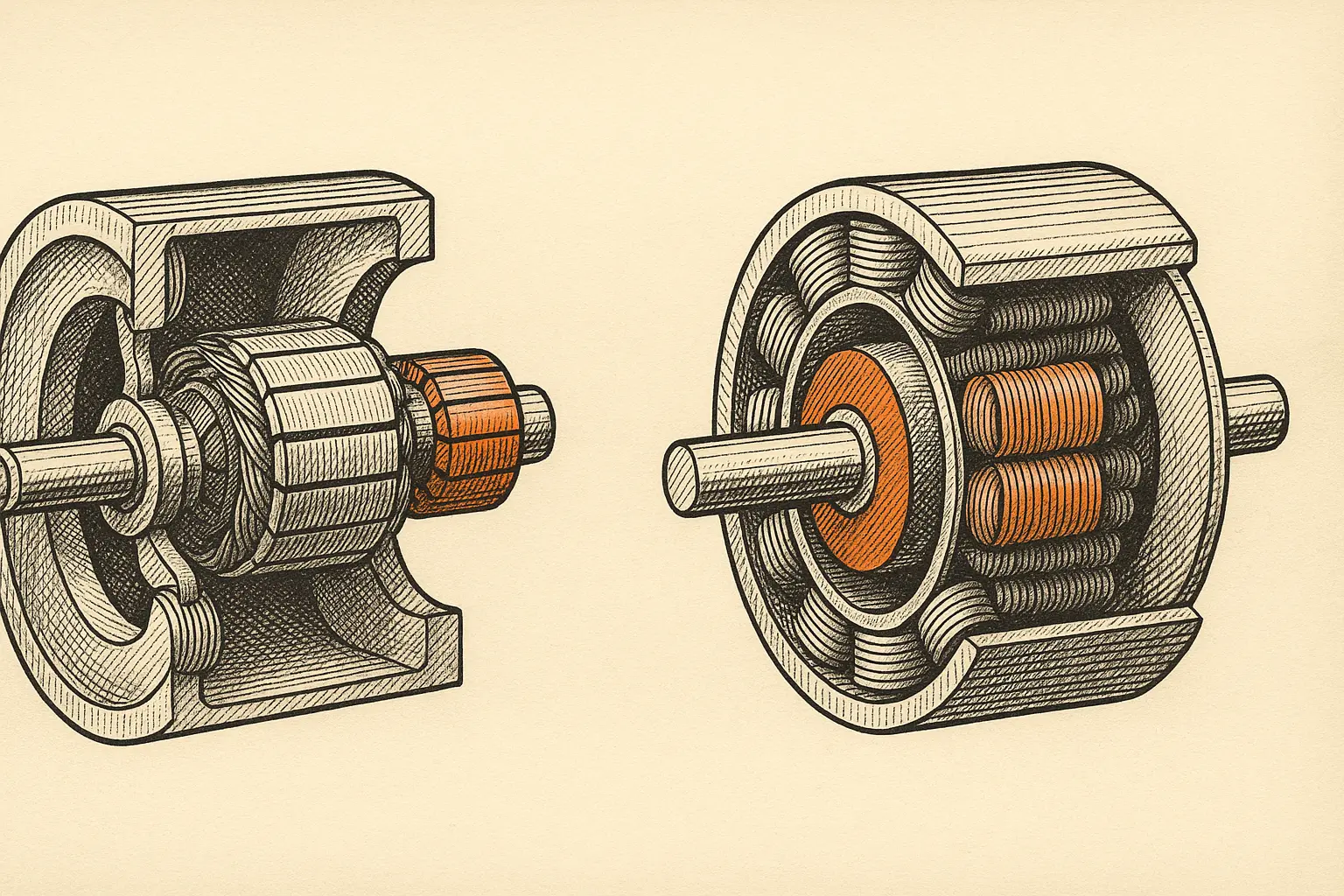
In a brushed DC motor, the permanent magnets stand still and the wound armature spins between them. Current reaches that spinning armature through a rotating switch: the commutator, a set of contact segments on the shaft, reverses the current direction through the windings each half-turn, and spring-loaded carbon brushes press against it to deliver the current — brushes "typically made of carbon or precious metals"[2]. The switching that keeps the motor turning is a mechanical rubbing contact, and that contact is where the losses live: as ToolGuyd's motor explainer puts it, "friction between the brushes and the commutator results in a slight drop in speed and thermal energy losses"[3].
A brushless motor turns the layout inside out: "permanent magnets are mounted on the rotor, and the electrified coils are located on the stator"[2]. Nothing needs to conduct current into the spinning part, so nothing rubs. The commutator's job moves into electronics — a controller sequences current through the stator windings, timed by rotor-position sensing ("Hall sensors are commonly used to detect the exact position of the rotor"[2]; commutation happens "electronically via an external controller and Hall-effect sensors"[1]). The consumable contact part is gone; in its place sits a circuit board.
That is the entire difference. Everything on the box — the power, runtime and lifespan claims — follows from removing one rubbing contact and adding one controller.
The evidence table#
| Property | Brushed | Brushless | Source |
|---|---|---|---|
| Commutation | Mechanical: carbon brushes on a rotating commutator | Electronic: controller + rotor-position sensors | ADVANCED Motion Controls [1]; ISL Products [2] |
| Efficiency (industrial reference figures) | ~60% | ~80% (slotted) to >90% (slotless) | ADVANCED Motion Controls [1] |
| Service life at 100% duty cycle | ~3,000 hours (brush wear limits it) | >10,000 hours | ADVANCED Motion Controls [1] |
| Maintenance | Brush inspection and replacement | "No brushes to inspect or replace — maintenance reduces to periodic bearing lubrication only" | ADVANCED Motion Controls [1] |
| Per-charge runtime, same drill | Baseline | "Might run anywhere from 30 to 50 percent longer" | Bob Vila [4] |
| Upfront cost | Lower — "comparable performance for as little as half the price" | Higher; ToolGuyd's stated disadvantage: "they cost more to end users" | Bob Vila [4]; ToolGuyd [3] |
Grade note: the efficiency and hour figures are Spec from an industrial motion-control vendor's published comparison[1], not from power-tool teardowns — the direction is solid engineering, the exact numbers describe industrial motors run at full duty, which your drill is not. We found no independent power-tool equivalent of this table (the gaps box).
BRUSHED ~3,000 H · BRUSHLESS >10,000 H ADVANCED Motion Controls, brushed-vs-brushless engineering comparison [1]
The reasoning: the arithmetic, shown#
Hours to wear-out, at your frequency. Take the industrial ~3,000-hour brushed figure[1] at face value and divide Inference: a homeowner's drill running 30 minutes a week logs 26 hours a year — about 115 years to the figure. An apprentice running two hours a day, 250 days a year, logs 500 hours a year — the same figure arrives in about six years, and the >10,000-hour brushless figure[1] pushes past twenty. The engineering numbers do not say "brushless is worth it"; they say whose hours make it worth it. This is the use-frequency half of the rule. The other half is failure cost: a stalled Saturday project and a stalled billable job are different losses on the same dead tool.
What the premium looks like on one brand's price sheet. Ryobi's own catalog sells both motors in the same 18V drill class (prices from ryobitools.com, retrieved 2026-08-05) Spec: the brushed PCL206K1 kit — up to 515 in-lb, 0–450 / 0–1,750 RPM, one 1.5Ah battery and charger — lists at $89.00[5]. The brushless PBLDD02K1 kit — up to 850 in-lb, 0–700 / 0–2,150 RPM, a 4Ah battery and charger, "over 45% faster drilling" — lists at $149.00, marked down from $169.00[6].
Read that gap honestly Inference: the $60 is not the price of a brushless motor. The dearer kit also carries a battery with more than twice the capacity and a 65%-higher torque rating — the catalog never sells you the motor alone, which is exactly why "brushless costs $60 more" is a sentence to distrust on any shelf. The cleanest same-brand claim we found is Ryobi's own, on its brushless PBLDD01B page: "Up to 20% Faster Drilling and Up to 50% More Torque" — with the baseline named as Ryobi's own brushed P215 drill[7].
What the flagship claims actually say. Milwaukee's M18 FUEL hammer-drill page credits its POWERSTATE brushless motor with "up to 10X longer motor life," "25% more power," "2X more runtime," and running "cooler with no wearable components"[8] Spec. Every load-bearing word there is "up to," and the page does not state what the multipliers are measured against. The one clause in that list you can verify from the engineering record is the last one: no wearable commutator contact is the defining feature of the motor type[1][2]. The multipliers may be true; they are not checkable from the page, and we grade them accordingly.
Runtime, the claim that matters most off-grid. The friction and heat a brushed motor spends at the commutator[3] is battery charge not reaching the chuck; Bob Vila's guide puts the resulting per-charge difference at 30 to 50 percent more runtime for a brushless drill against the same drill brushed[4]. That is a generalist's range across the category, not a measurement of any pair on your shelf — but its direction follows from the mechanism, and it compounds with pack size (the watt-hour arithmetic lives in the battery-platform audit).
The safety file#
Motor type does not change the rules that apply to the tool. The construction of hand-held electric tools is certified to the harmonized Standard IEC/UL/CSA 62841 series, which covers "hand-held tools, transportable tools, and lawn and garden machinery"[9]. Intertek's standards notice names UL 62841-1 ("Electric Motor-Operated Hand-Held Tools, Transportable Tools and Lawn and Garden Machinery — Safety") as "the superseding standard" for the older hand-held tool standard UL 60745-1, with the old standard's expected withdrawal on 2028-02-10[10] — brushed or brushless, the certification mark is the thing to look for on the nameplate.
One motor-specific fact belongs here: a brushed motor's commutator contact arcs in normal operation, and in flammable atmospheres "brush sparks are a direct ignition hazard"; electronic commutation removes the spark source[1]. For driving deck screws this is trivia. Around fuel vapor, solvent fumes or fine dust, it is a real line between the two motor types, and it runs in brushless's favor.
What breaks#
- Brushes, progressively. The documented symptom pattern of worn brushes is "stuttering motor, or a power tool that stops and starts erratically"[4]. This failure announces itself, arrives roughly on the hour clock above, and on serviceable tools is a cheap parts swap — the gentlest failure mode on this page.
- The commutator itself. The brush is designed to be the sacrificial half of the contact, but the commutator it rubs against "can also wear out"[4] — and that is a motor replacement, not a brush swap.
- Heat, under sustained load. The brushed motor's friction losses leave as heat[3], on top of the resistive heating both types share; the same published figures that put brushed efficiency at ~60% against ~80–90%+ brushless[1] describe energy that becomes temperature instead of torque.
- The electronics, in brushless tools. The brushless design trades the consumable contact for a controller and sensors[1][2]. We found no published failure-rate data on power-tool controller boards, so we will not invent any — but note the shape of the trade: the brushed failure is gradual, cheap and user-serviceable; an electronics failure is none of those three.
What the evidence doesn't cover#
Owning the gap is the policy here, so plainly: we could not find a controlled, instrumented lifespan test that runs matched brushed and brushless power tools to failure. The independent testers this site cites in other categories have not, as far as our search found, published one. That means:
- The ~3,000 vs >10,000-hour figures come from an industrial motion-control vendor's engineering comparison[1], describing industrial motors at 100% duty — a regime no drill lives in. Brush life in practice varies widely with load, speed and environment.
- The 30–50% runtime figure is a published generalist range, not a measured result for a specific tool pair[4].
- Manufacturer multipliers — "up to 10X longer motor life"[8] — state no baseline and no test method on the pages that carry them, and no independent verification of them was found.
- No published data we consider citable compares failure rates of brushless controller electronics against brush wear-out in tools. The "what breaks" trade above is reasoned from the designs, not measured.
This is why the guide gives you a decision rule instead of a verdict: the direction of the evidence is consistent and well-documented; the magnitudes on the boxes are not independently verified, and we will not pretend otherwise.
Sources ledger#
- ADVANCED Motion Controls, "Brushed vs Brushless Motor: Key Differences, Performance, and How to Choose" — mechanical vs electronic commutation; efficiency ~60% brushed vs ~80% slotted / >90% slotless brushless; ~3,000 vs >10,000 hours at 100% duty; maintenance reduced to bearing lubrication; brush sparks as an ignition hazard. Industrial motion-control vendor; graded as engineering reference, not tool test.
- ISL Products, "Brushless DC Motors vs. Brushed DC Motors" (design note) — construction of both types; the commutator as rotating switch; brush materials; magnets on the rotor and coils on the stator in BLDC; Hall-effect rotor-position sensing.
- ToolGuyd (Stuart), "Power Tool Tech: Brushless Motors 101" (orig. 2012-02-08, updated 2014-10-30) — brush-commutator friction and thermal losses; claimed brushless benefits in cordless tools (more power, longer runtime, less maintenance); the stated disadvantage: "they cost more to end users."
- Bob Vila (Bob Beacham), "Brushless vs. Brushed Motor: Which Is Best for Your Power Tools?" (updated 2022-02-23) — 30–50% longer per-charge runtime for a brushless drill vs the same drill brushed; brushed at "as little as half the price"; infrequent users may never wear out brushes; brush-wear symptoms; commutator wear.
- Ryobi, 18V ONE+ 1/2 in. Drill/Driver Kit, PCL206K1 (product page) — brushed; $89.00 list; up to 515 in-lb; 0–450 / 0–1,750 RPM; (1) 1.5Ah battery and charger. Retrieved 2026-08-05.
- Ryobi, 18V ONE+ HP Brushless 1/2 in. Drill/Driver Kit, PBLDD02K1 (product page) — $149.00 list, shown reduced from $169.00; up to 850 in-lb; 0–700 / 0–2,150 RPM; 4Ah battery and charger; "over 45% faster drilling." Retrieved 2026-08-05.
- Ryobi, 18V ONE+ HP Brushless 1/2 in. Drill/Driver, PBLDD01B (product page) — "Up to 20% Faster Drilling and Up to 50% More Torque" compared to Ryobi's own brushed P215; up to 750 in-lb. Retrieved 2026-08-05.
- Milwaukee Tool, M18 FUEL 1/2 in. Hammer Drill/Driver Kit, 2604-22 (product page) — POWERSTATE brushless motor claims: "up to 10X longer motor life," "25% more power," "2X more runtime," runs "cooler with no wearable components"; baselines not stated on the page. Retrieved 2026-08-05.
- IAEI Magazine (Intertek), "Navigating IEC/UL/CSA 62841 for Power Tool Safety" (Certification Insights, Summer 2024) — "IEC/UL/CSA 62841 is the international standard series that addresses the safety of electric, motor-operated, or magnetically driven tools with provisions for hand-held tools, transportable tools, and lawn and garden machinery."
- Intertek, Standards Update Notice, CAN/CSA C22.2 No. 60745-1 / UL 60745-1 (PDF, issued 2018-05-25) — "introduces CAN/CSA C22.2 No. 62841-1 / UL 62841-1 as the superseding standard"; full title of the superseding standard, "Electric Motor-Operated Hand-Held Tools, Transportable Tools and Lawn and Garden Machinery – Safety – Part 1: General Requirements"; the superseded standard's "expected withdrawal date of February 10, 2028."
Change notes#
Cite this page: Precious Handyman, "Brushless vs Brushed: What the Premium Actually Buys," updated 2026-08-05, https://precioushandyman.com/brushless-vs-brushed/