Buying guide · The first toolbox
The First-Home Toolbox, Bought in the Right Order
The house is yours as of Friday, and by Sunday it has already spoken: the bathroom door doesn't latch, the previous owner's towel bar comes off the wall with one anchor still spinning in the drywall, and something behind the toilet hisses faintly whenever it refills. None of these is a project. Each is a twenty-minute repair — for someone who owns a screwdriver, a pair of pliers, and an adjustable wrench, which as of Sunday you do not.
This guide is about buying that toolbox in the right order, without buying twice and without buying a wall of tools you will not touch for years. It is an audit, not a diary: as explained in How We Source, we don't run a test lab, and we won't pretend to. Every figure below traces to a published price, a named independent test, a peer-reviewed study, or a safety standard, each keyed to the Sources Ledger at the foot of the page.
The decision, up front #
There is no "best starter tool kit." There is one principle and one fork. The principle: buy for the repair that arrives first, not the project you imagine. The loose hinge and the running toilet show up in week one; the deck you are picturing may never happen, and the tools it needs can be bought the week it does. The fork: whether the boxed kit or the piecemeal route gets you there for less — which turns out to be an arithmetic question, worked below. Here is how it resolves by situation, each verdict with its downside stated:
- First-house DIYer: buy the stage-one hand tools piecemeal, add a drill/driver and two bit sets within the first month, and rent anything with a motor bigger than the drill's (the rent line, below). Downside: piecemeal takes more decisions than one box off the shelf, and nobody hands you a case it all fits in.
- Renter or apartment DIYer: stage one only — the fastener-and-faucet layer. Most of what fails in an apartment is legally the landlord's problem; buy the tools that hang pictures and tighten what wobbles. Downside: the day you close on a house, stage two starts at zero.
- Apprentice with a shop list: your local or shop hands you a mandated tool list; buy that, exactly, and nothing this page says overrides it. This guide's arithmetic still applies to what you buy for home. Downside: pro-grade prices on day-one wages.
- Homesteader or rural buyer: same staged core, but the rent-versus-buy line sits differently — when the nearest rental counter is an hour away and the post holes number in the dozens, owning an auger starts beating renting one (arithmetic below). Downside: rural ownership math justifies a shed full of single-purpose machines one at a time, and storage plus maintenance is a real cost this page cannot price for you.
Stage one: the tools the first repairs actually use #
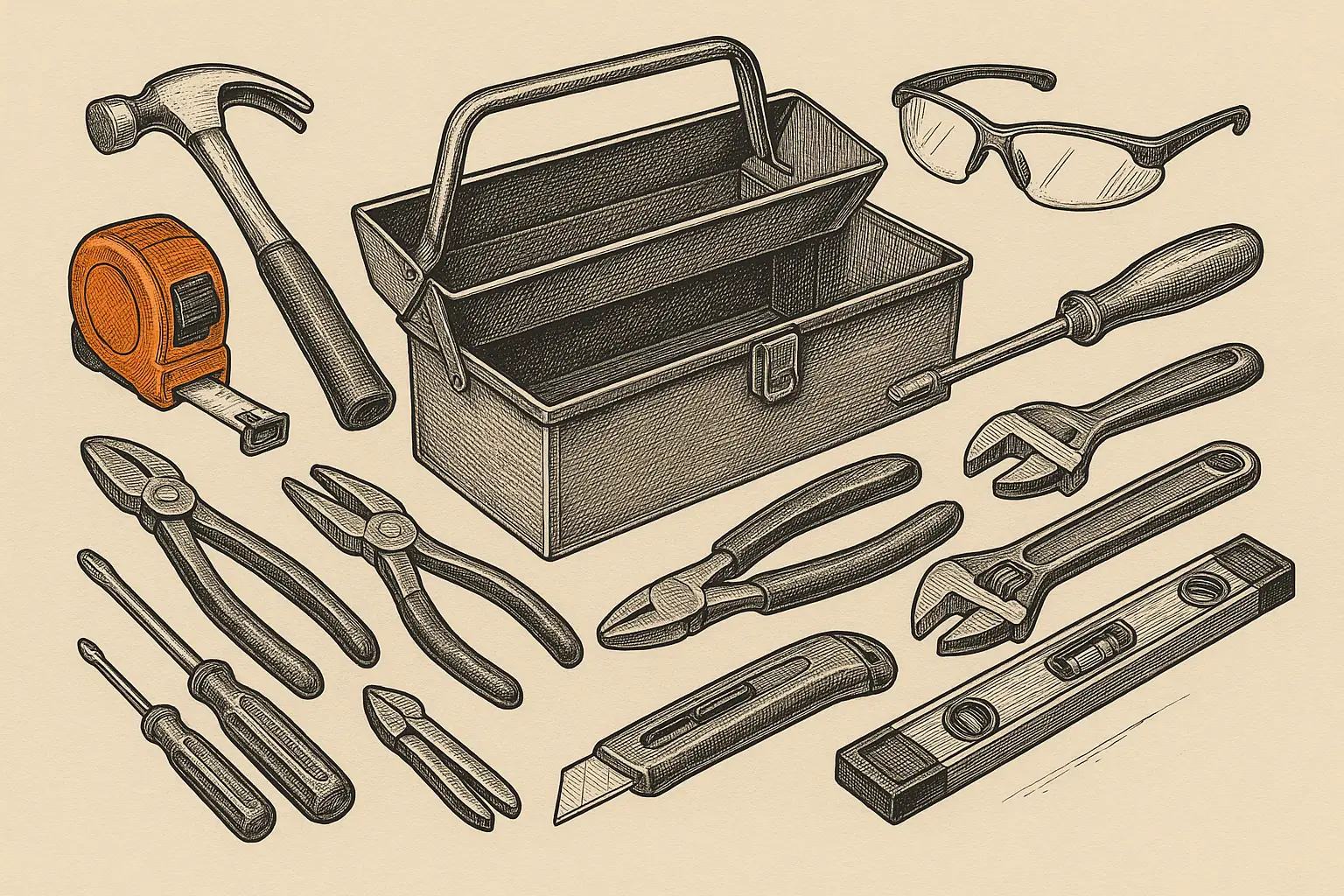
Walk back through the opening paragraph. The door that won't latch wants a screwdriver on the strike plate. The failed towel bar wants pliers to extract the spun anchor, a utility knife to clean the hole, and a screwdriver for the new anchor. The hissing toilet wants an adjustable wrench on the supply-line nut. Add the jobs of the first months — hanging things, measuring for furniture, cutting boxes, finding what's behind the drywall before you put a screw into it — and the day-one list writes itself:
- a claw hammer;
- a tape measure;
- screwdrivers — or a driver handle with a bit assortment (stage two's bit set does double duty here);
- slip-joint or groove-joint pliers, plus needle-nose;
- an adjustable wrench;
- a utility knife with spare blades;
- a torpedo level;
- a stud finder, or at minimum a magnet that finds drywall screws;
- an assortment of drywall anchors and common fasteners;
- a flashlight or headlamp;
- safety glasses marked "Z87" — the marking defined by ANSI/ISEA Z87.1, the same standard OSHA rule text requires of employer-provided eye protection[12].
Nothing on that list has a motor, and the whole layer costs less than most single power tools. Which raises the obvious question: isn't there a box that just contains all of it?
The boxed kit vs piecemeal, by the piece #
The big-box "N-piece set" is priced to look like the shortcut. The piece count is doing more marketing work than you might think, and you don't have to take our word for it — the tool trade press has done the counting. ToolGuyd's Stuart, examining the Craftsman CMMT45242 mechanics set that Lowe's ran as a $99 holiday price leader (marked down from a claimed $219), published the full piece breakdown[1]:
| What's in the 242 pieces | Count | Source |
|---|---|---|
| Ratchets (1/4", 3/8", 1/2") | 3 | ToolGuyd [1] |
| Sockets | 84 | ToolGuyd [1] |
| Bit sockets | 11 | ToolGuyd [1] |
| Combination wrenches | 10 | ToolGuyd [1] |
| Extensions, universal joints, bit driver | 6 | ToolGuyd [1] |
| Hex keys | 28 | ToolGuyd [1] |
| Screwdriver bits | 88 | ToolGuyd [1] |
| Nut driver bits | 12 | ToolGuyd [1] |
Tested His reading of sets like this one is blunt: "I tell everyone to look at the tool and socket count, and consider the screwdriver bits as 'fillers' that inflate the parts count"[1]. (He still judged this particular set a good deal at $99 — the filler critique and the verdict coexist.)
Inference Now the arithmetic, shown. Of 242 pieces, 128 — the hex keys, screwdriver bits, and nut driver bits — are the filler categories, which is 53% of the count. Divide the $99 by the advertised 242 pieces and the set costs about 41 cents a piece; divide it by the 114 tools and sockets and it costs about 87 cents per piece you would plausibly have bought on purpose. Still cheap — but the number on the box overstated the value by half.
The quieter problem is what the box does not contain. Read the breakdown again: it is drive tools, sockets, wrenches, bits and keys, end to end[1]. A mechanics set — which is what most big price-leader sets are — contains no hammer, no tape measure, no level, no utility knife, and no pliers. It is a fine second box for the day you work on cars. It does not close a single repair in this guide's opening paragraph. That, more than the per-piece math, is the case for buying the first toolbox piecemeal: the boxed kit optimizes for a piece count, and the staged list optimizes for the repairs that actually arrive.
Stage two: the drill, and the bits that are the real purchase #
The first power tool worth owning in a house is a cordless drill/driver, because it is the one that stage-one jobs keep almost needing: pilot holes, anchor holes, screws by the dozen when one shelf becomes four. Which drill is a platform decision — the batteries you buy into matter more than the first tool that carries them — and that fork gets its own guide. What belongs in the first-toolbox budget is the part people skip: the bits.
Spec Two dated price points from ToolGuyd's home-kit recommendations (June 2024): a Milwaukee 74-piece Shockwave screwdriver bit assortment (48-32-5154) at $19.88, and a DeWalt 14-piece twist drill bit set (DWA1184, 1/16" to 1/2") at $9.98 — "the value can't be beat," in Stuart's words[2]. Call it thirty dollars for both: the entire fastening-and-drilling capability layer, at the price of a pizza dinner.
Tested On what separates cheap bits from dear ones, the most useful published data we know of is Project Farm's drill-bit-set comparison. Todd Osgood — who buys every product with his own and Patreon funds and accepts no manufacturer sponsorships, which is why this site treats his results as citable[4] — ran thirteen-plus brands of twist bits through mild steel, spring steel, and AR500 armor plate, measuring drilling speed and hole finish. In his results, the budget COMOWARE M42 cobalt set posted the best average finish score (1.6, lower is better) and was the fastest of the sets that completed the AR500 plate; a $13 DeWalt high-speed-steel set was his value pick but, in his words, "lost performance quickly in tougher tests"; Milwaukee's $65 cobalt set scored a solid 2.4. Set prices in the field ran $13 to $180[3].
The homeowner translation: for wood and drywall, the cheap high-speed-steel set is genuinely fine — the differences Project Farm measured appear in steel, and hardened steel at that. If your house's jobs include metal, the test says the step up worth taking is cobalt, and it does not say the priciest box wins.
Stage two is also where the sealed-tube jobs arrive — a re-caulked tub edge, a bead around the exterior penetrations before winter — so add a caulk gun. (If an old link about caulking-gun roundups brought you to this address: this staged list is what lives here now, and the caulk gun's place in it is this paragraph.)
The rent-don't-buy line #
Past the drill, every tool with a motor deserves one question before it deserves a purchase: how many days of use will this see before the house is done needing it? Big-box rental counters price tools in 4-hour, daily, weekly and 4-week blocks[5], which makes the comparison a division problem. Three classic first-house temptations, priced both ways from published rates and list prices (all checked 2026-08-05; rental rates vary by store and region):
| Tool | Published rental rate | Published purchase price | Break-even (our division) |
|---|---|---|---|
| Drum floor sander | $42–$200/day; Home Depot $75/day[5] | $7,656 list (American Sanders EZ-8)[6] | ~102 rental days at $75 |
| Breaker / demolition hammer | $40–$150/day[7] | ~$1,529–$1,780 (Bosch BH2760VC)[8] | ~17 rental days at $90 |
| One-man post-hole auger | $75/day (one published listing)[9] | varies widely by class | rate ≈ a day's rental per fence weekend |
Inference The division, shown: $7,656 ÷ $75 per day ≈ 102 days. A floor gets sanded once, maybe twice, in an ownership; nobody sands floors 102 days without being in the flooring trade. The breaker's arithmetic is $1,529 ÷ $90 ≈ 17 days — closer, but a homeowner demolition job is measured in days, not months, and the machine spends the following decade being heavy in a corner. Hence the rule this section is named for: if the realistic days of use don't reach the purchase price divided by the day rate, rent. The homesteader exception from the decision box is the same rule run with honest inputs — dozens of post holes across years of fencing, plus an hour's round trip per rental, moves the auger's arithmetic toward owning.
One caution on the numbers themselves: rental pricing is set per store, so treat the table's rates as the published range, not a quote — Bob Vila's rental-cost survey (updated June 2024) is the source for the sander figures, and it found Home Depot's own drum-sander pricing running about $53 for a four-hour window, $75 a day, and roughly $900 a month[5].
The safety file: the ladder is the dangerous purchase #
The first toolbox usually gains a ladder in month one, and the ladder — not the utility knife, not the drill — is the item on this page with a body count.
Tested That figure is a peer-reviewed NEISS analysis by the Center for Injury Research and Policy at Columbus Children's Hospital, published in the American Journal of Preventive Medicine: more than 2.1 million ladder injuries treated in US emergency departments over 1990–2005, about 136,000 a year, 77% of them men, with the annual number of injuries rising more than 50% across the study period. Two details matter for a homeowner: 97% of the injuries were non-occupational — homes and farms, not job sites — and nearly 10% of cases ended in hospital admission, roughly double the admission rate for consumer-product injuries overall[10]. The ladder aisle is where the first-toolbox budget should stop being frugal.
Standard The spec that prices ladders is the duty rating, set by the ANSI-ASC A14 ladder standards — and A14-compliant ladders are treated as meeting OSHA's design requirements[11]:
| Duty rating | Class | Max load | Source |
|---|---|---|---|
| Type III | Household | 200 lb | ANSI-ASC A14 via VT EHS [11] |
| Type II | Commercial | 225 lb | ANSI-ASC A14 via VT EHS [11] |
| Type I | Industrial | 250 lb | ANSI-ASC A14 via VT EHS [11] |
| Type IA | Extra heavy duty | 300 lb | ANSI-ASC A14 via VT EHS [11] |
| Type IAA | Special duty | 375 lb | ANSI-ASC A14 via VT EHS [11] |
Read the fine print the way the standard means it: the rating covers everything on the ladder at once — you, your clothes, the tool belt, and the bundle of shingles — not your bathroom-scale weight[11]. A 190-lb person carrying a loaded tool bag is already past a Type III's 200-lb rating. The cheap household ladder is the one first-toolbox bargain this page recommends against on the numbers.
Standard And the safety glasses from stage one are not a garnish: the "Z87" marking traces to ANSI/ISEA Z87.1, the standard OSHA's eye-protection rule (29 CFR 1910.133) requires employers to meet[12]. A homeowner answers to no OSHA inspector, but the eyeball being protected is the same organ the rule was written for.
What breaks #
- Cheap twist bits, fast, in metal. Project Farm's measurements are the receipt: the $13 high-speed-steel set that was his value pick "lost performance quickly in tougher tests," and the worst set in the field wore visibly in the harder materials[3]. Bits are consumables; budget accordingly.
- The piece count's promise. The documented failure of the boxed-kit shortcut is not that the tools snap — it is that half the count is filler bits and the box never contained the hammer, tape, level or pliers the first repairs needed[1], so the buyer of the 242-piece set still goes back to the store in week one.
- People, off ladders. 136,000 emergency visits a year, 97% of them not at work[10]. The failure mode of the first toolbox's tallest item is the user.
What the evidence doesn't cover #
Owning the gap is part of the method here, so: we know of no large-sample, published reliability data for basic hand tools — no one lab-tests claw hammers at scale, and the stage-one list above is reasoning from the jobs, not from head-to-head measurements. The prices in this guide are dated snapshots (checked 2026-08-05, or as dated inline); sale prices like the $99 kit are by nature temporary, and rental rates are set store-by-store, so run the rent-line division with your own counter's numbers before deciding. And the feel of a tool in your hand — handle shape, weight, balance — is a real purchase factor no document settles. For the tools you will hold a thousand times, the honest move is to hold the candidates in a store first.
Sources Ledger #
- ToolGuyd (Stuart), "Is Craftsman's New $99 Mechanics Tool Set a Good Deal?" — Oct 19, 2025; CMMT45242 piece breakdown, pricing, and the filler-pieces analysis quoted above. toolguyd.com.
- ToolGuyd (Stuart), "Home Tool Kit: Drill and Screwdriver Bit Sets" — Jun 25, 2024; Milwaukee 48-32-5154 at $19.88, DeWalt DWA1184 at $9.98, quotes as cited. toolguyd.com.
- Project Farm (Todd Osgood), budget drill bit set comparison — brands, test materials (mild steel, spring steel, AR500), finish scores and value findings as cited. projectfarmreviews.com summary.
- Project Farm, Patreon about page — self-funded purchasing, no manufacturer sponsorships. patreon.com/projectfarm.
- Bob Vila, "Renting a Floor Sander: How Much It Costs and What to Expect" — updated Jun 3, 2024; daily and monthly rental ranges by company, 4-hour windows. bobvila.com.
- American Sanders official store, EZ-8 expandable-drum floor sander (model 0705) — $7,656.00 list price, checked 2026-08-05. americansanders.com.
- Rentd, "How Much Does It Cost to Rent a Breaker / Jackhammer?" — 2026 rate guide; $40–$150/day range, heavier units higher. rentd.com.
- Bosch BH2760VC Brute breaker hammer retail listings, checked 2026-08-05 — Toolup, $1,529.00; Ace Hardware, $1,779.99.
- EP Tool Rental, published listing — 48 cc one-man post-hole auger with 8-in. bit, $75.00/day. eptoolrental.com.
- D'Souza, Smith et al. (Center for Injury Research and Policy, Columbus Children's Hospital), "Ladder-Related Injuries Treated in Emergency Departments in the United States, 1990–2005," American Journal of Preventive Medicine, May 2007 — figures as cited. ajpmonline.org; ScienceDaily summary of the study.
- Virginia Tech Environmental Health & Safety, ladder safety program page — ANSI-ASC A14 duty ratings (Type III 200 lb through Type IAA 375 lb), total-load definition, and ANSI-compliance-meets-OSHA note. ehs.vt.edu.
- OSHA, 29 CFR 1910.133, "Eye and face protection" — incorporates ANSI/ISEA Z87.1 for protective eyewear. osha.gov rule text.
Change notes #
Cite this page: "The First-Home Toolbox, Bought in the Right Order," Precious Handyman, updated 2026-08-05, https://precioushandyman.com/first-toolbox/