Buying guide · Backup & homestead power
Sizing a Generator: The Wattage Arithmetic, Shown
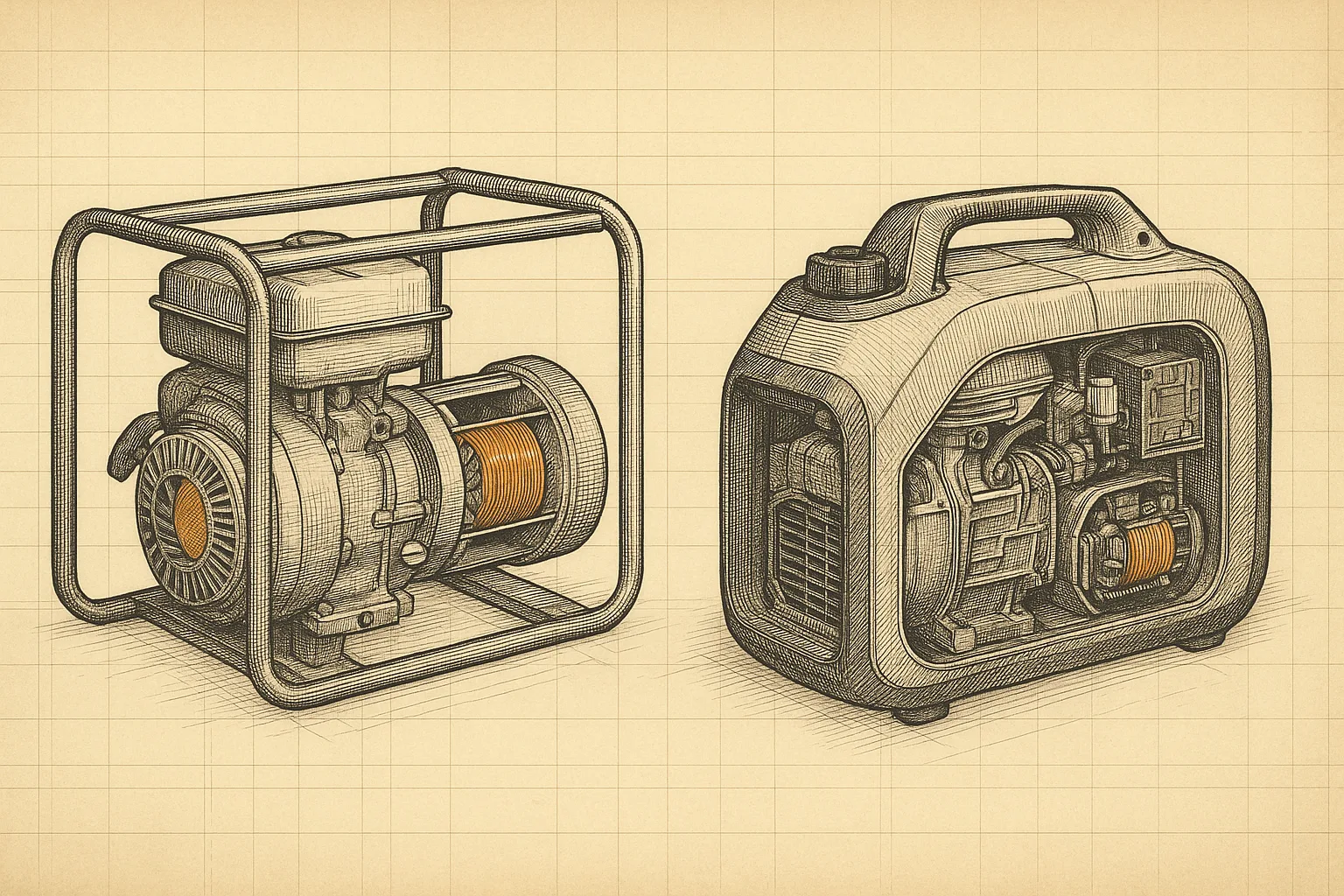
The power went out an hour ago, the sump pit is filling, and the freezer holds a season of garden work and half a hog. The question in front of you is not "which generator is best" — it is a sum: what do the refrigerator, the sump pump, and the lights draw at the same moment, and what does the biggest motor among them demand in the second it starts? Get that sum right and a mid-size machine carries the house; get it wrong and the breaker trips at the worst possible moment, in the dark, in the rain.
This guide is an audit, not a diary. As explained in How We Source, we don't run a test lab, and we won't pretend to: every figure below traces to a published wattage worksheet, a manufacturer's own spec page, a federal safety publication, or a named industry standard, and each claim carries a numbered marker keyed to the Sources Ledger at the foot of the page.
The decision, up front #
There is no "best generator." There is a fork — what is the largest load you must start, and how many hours must the machine run? Those two numbers, worked below, sort the market before any brand does. Here is how the fork resolves by situation, each verdict with its downside stated:
- First-house DIYer (fridge, sump pump, lights): the worked sum below lands a typical outage kit near 4,000 running watts with a 2,200-watt starting surge on top[1], which is mid-size open-frame territory. Downside: conventional open-frame machines are the loud, high-distortion end of the market — up to roughly 25% total harmonic distortion under heavy load by one industry explainer's figure[4] — so plan on plugging electronics in with care, or paying the inverter premium.
- Small contractor: conventional open-frame units "deliver more power for the money (since inverter technology comes at a cost)" and reach much higher wattage classes — that trade-off is printed in the wattage worksheet DR Power hands its own buyers[2]. Downside: the same document concedes the bulk and the noise, and a 74 dB(A) spec is normal for the class[5].
- Homesteader / rural property owner: the well pump changes everything: it is a hard-starting motor load, neither published worksheet we cite even lists one, and powering it means feeding house circuits — which requires a transfer switch installed by an electrician, never a cord into a wall outlet[9]. A dual-fuel machine adds propane's storage convenience. Downside: on propane the same machine makes about 10% fewer watts — Champion's own dual-fuel spec sheet says so in plain numbers[5].
- Renter, camper, or tailgater: the quiet suitcase inverter class, exemplified by Honda's EU2200i — 2,200 watts maximum, 1,800 rated, 48–57 dBA[3]. Downside: by the worksheet's own chart figures, a refrigerator alone can demand 2,900 watts at the instant of start-up — more than this whole class produces[1]. Check your appliance's nameplate before assuming a suitcase unit will carry it.
- The whole-house buyer: if the goal is every circuit, automatically, this guide's subject — portable generators — is the wrong tool. That is standby-generator territory, a permanently installed and professionally sized purchase we do not cover here.
Running watts, starting watts, and the sum that sizes the machine #
= MINIMUM GENERATOR RATING The sizing method printed on the published wattage worksheets[1][2]
Spec Every appliance has one number that matters continuously and, if it contains a motor, a second number that matters for about a second. Running watts is the continuous draw. Starting watts is the extra surge a motor demands as it spins up from a standstill — and the published worksheets put it as high as the running figure or higher. The Lowe's-distributed wattage worksheet lists a refrigerator/freezer at 700 running watts plus 2,200 additional starting watts, and a ½ HP sump pump at 1,050 plus 2,150[1]. DR Power's worksheet states the rule of thumb outright — "Starting watts are typically 2X running watts" — and tells you to check your product literature for the actual running and starting figures[2].
Spec The sizing method both documents print is the same four steps: choose the devices you need at the same time, total their running watts, then add the single highest starting figure — not every starting figure — because the method "assumes starting one product at a time"[2]. That assumption is load management, and it is free: switch things on one at a time, biggest motor first, and you only ever pay one surge.
Inference Here is the sum worked in the open, using the worksheet's own chart figures for a plausible outage kit[1]:
| Device | Running watts | Additional starting watts | Source |
|---|---|---|---|
| Refrigerator/freezer | 700 | +2,200 | [1] |
| Sump pump, ½ HP | 1,050 | +2,150 | [1] |
| Television, 27 in. | 500 | — | [1] |
| Microwave, 1000 W | 1,000 | — | [1] |
| Computer with 17 in. monitor | 800 | — | [1] |
| Total running | 4,050 | ||
| + highest starting (refrigerator) | +2,200 | ||
| Minimum rating | 6,250 W | ||
So the modest-sounding kit above wants a machine rated around 6,250 starting watts — which is almost exactly the worksheet's own worked example, where a refrigerator, sump pump, belt sander and small compressor total 3,950 running watts plus a 2,400-watt surge for a 6,350-watt answer[1]. Two honest caveats, both printed on the worksheet itself: "Watts listed are approximate. Check your appliance for actual requirements," and the totals assume intermittent, staggered starting[1]. If your appliance's nameplate lists amps instead of watts, DR Power's sheet gives the conversion: multiply amps by 120 volts — a 20 A device is 2,400 watts[2].
Inference One line in the chart deserves its own warning. A 12,000 BTU window air conditioner is listed at 3,250 running watts plus 3,950 starting[1] — 7,200 watts at the moment it kicks on, more than the entire kit above. Air conditioning is the load that quietly pushes a "medium" generator purchase into the large-frame class. Decide whether you are buying backup for the freezer or backup for comfort; they are different machines.
Inverter vs conventional: what the machines actually do differently #
Spec A conventional portable generator holds one engine speed no matter the load: "On a conventional portable generator, the engine speed is fixed—typically at 3600 RPM—and always runs at that speed," because engine speed is what sets the 60 Hz frequency of the output[4]. An inverter generator breaks that link: it lets the engine speed rise and fall with the load, rectifies the variable output to DC, and electronically rebuilds a clean 60 Hz waveform[4]. Two consequences follow directly, and both show up on spec sheets.
Spec First, fuel. Because the engine can loaf when the load is light, an inverter's runtime spec is quoted as a range: Honda's EU2200i runs "3.2 to 8.1 hours on a single tank, depending on the load" — a 0.95-gallon tank — a spread Honda credits to its Eco Throttle system[3]. That 2.5-to-1 spread on one tank is the manufacturer's own documentation of the variable-speed fuel curve; a fixed-speed machine has no such trick available.
Spec Second, power quality. Total harmonic distortion — how far the output waveform deviates from a clean sine — runs "up to 25%" on conventional units under heavy load by the industry explainer's figure, while inverter makers "frequently tout less than 3% THD"[4]. DR Power's buyer-facing worksheet says the same thing in plainer words: inverters produce "clean, reliable power that is well suited to today's sensitive electronics," while conventional machines "deliver more power for the money" and come in much larger wattage classes[2]. That is the whole fork: watts per dollar against cleanliness, weight and noise — the EU2200i's 48–57 dBA against the 74 dB(A) Champion publishes for its 6,500-watt open-frame dual-fuel[3][5]. Neither side is wrong; they are priced for different jobs.
The fuel fork, in Btu and hours #
PROPANE CARRIES ~24% LESS ENERGY PER GALLON U.S. Energy Information Administration heat contents[6]; percentage is our arithmetic
Spec Dual-fuel machines make the trade explicit on their own spec sheets. Champion's 6,500-watt dual-fuel generator (model 201077) is rated 8,125 starting / 6,500 running watts on gasoline and 7,325 starting / 5,850 running watts on propane — the same engine gives up about 10% of its output on the lower-energy fuel[5]. Champion also publishes the runtimes: 11 hours at 50% load on the full 7.7-gallon gasoline tank, and 6.5 hours at 50% load on a standard 20-lb propane cylinder[5]. Size to the propane numbers if propane is what you will actually burn in a storm; the gasoline rating on the box is the fuel you may not have.
Inference Those figures let you plan fuel like a quartermaster instead of guessing. At Champion's own 50%-load rate, the gasoline tank burns 7.7 gallons in 11 hours — 0.7 gallons per hour. A three-day outage at 12 generator-hours a day is 36 hours: roughly 25 gallons of gasoline, or five to six 20-lb propane cylinders at 6.5 hours each[5]. Whichever fuel you choose, that storage problem — cans or cylinders, rotated and stored safely — is part of the purchase, and it is bigger than most buyers picture. It is also propane's real argument: cylinders are sealed, swappable at any hardware store, and already sitting under half the grills in America.
The safety file: carbon monoxide and the cord that kills linemen #
EXHAUST POINTED AWAY · NEVER IN A GARAGE, EVEN OPEN CPSC, "What to Know About Generators and Carbon Monoxide"[7]
Standard The deadliest thing about a portable generator is not electrical. The U.S. Consumer Product Safety Commission's generator publication states that "more than 80 consumers die each year from CO poisoning caused by portable generators," and its danger label is written in absolutes: "Using a generator indoors CAN KILL YOU IN MINUTES," and "NEVER use inside a home or garage, EVEN IF doors and windows are open."[7] The operating rule is just as specific: outside only, "at least 20 feet away from the house," exhaust directed away from the home and other buildings, and never in a basement, crawlspace, shed or on a porch[7]. CPSC also tells buyers to install battery-operated CO alarms outside sleeping areas and on every floor, and to test them monthly[7].
Standard The product standard has caught up with the death toll. ANSI/PGMA G300-2023 — approved by ANSI on December 19, 2023, applying to all portable generators 15 kW and smaller, and in effect for units manufactured on or after January 1, 2025 — requires a CO sensing system that shuts the generator down automatically when carbon monoxide accumulates around it[8]. The manufacturers' association credits the sensing technology, carried over from the 2018 edition, with a 99% reduction in deaths from generators run indoors — the industry's own figure, so read it as the maker's claim, not an independent one[8]. On spec sheets the feature travels under brand names: Honda's CO-MINDER, for instance, "continuously monitors carbon monoxide (CO) levels" and "automatically shuts down the generator before detected CO levels near the generator become dangerously high"[3]. CPSC's buying advice is simply to ask for the shut-off feature[7]; on the current market there is no good reason to buy a unit without it. A shut-off is a backstop for a mistake, not permission to make one — the 20-foot rule still governs.
Standard The electrical rule is shorter. The Electrical Safety Foundation International: "NEVER connect generators directly to household wiring without first installing a transfer switch" — the transfer switch is what prevents backfeeding, which "could electrocute utility workers making repairs" on lines they believe are dead[9]. Plugging appliances into the generator's own receptacles with proper outdoor-rated cords is fine; energizing the house's circuits is an electrician-installed transfer switch or nothing. The improvised alternative — a double-male cord into a wall or dryer outlet — puts your generator's output onto the utility's lines and onto whoever is up a pole repairing them.
What breaks #
- The sizing, at start-up. A machine sized on running watts alone meets its first motor surge and trips its breaker or stalls — the entire reason both published worksheets are built around the starting-watts column[1][2]. Undersizing is a purchase error, not a product defect.
- The propane assumption. Buyers who size on the gasoline rating and run on propane are down about 10% of rated output before the first load connects[5] — which can be exactly the margin the biggest motor start needed.
- The operator. The documented fatal failure mode of this product is placement: more than 80 CO deaths a year, overwhelmingly from generators run indoors or too close to the house[7]. The G300 shut-off requirement exists because this failure was common enough to write a standard for[8].
- The improvised hookup. Backfeeding through a wall outlet endangers line workers and bypasses every protection a transfer switch provides[9]. It is the one mistake on this page that mostly kills someone other than the person who made it.
What the evidence doesn't cover #
Owning the gap is part of the method here, so: the appliance wattages in the table are the worksheets' approximations, and both sheets say so — your refrigerator's nameplate, not their chart, is the number that counts. Neither cited worksheet lists a well pump, so homesteaders sizing for one must work from the pump's own nameplate and its manufacturer's starting figures; we will not invent a number for it. The runtime and noise figures on this page are manufacturer specs, not independent measurements — we know of no controlled, cross-brand generator test we can cite for them, and we did not run one. And the 99% figure attached to CO shut-off systems is the manufacturers' association's own; an independent long-run tally of the technology's real-world record does not yet exist. Where those gaps matter to you, this page cannot close them, and it won't pretend to.
Sources Ledger #
- "Wattage Worksheet," portable generator sizing sheet distributed by Lowe's (reorder #G225540, form 0203920, 04/2017) — the four-step sizing method, the appliance running/starting chart (refrigerator/freezer 700/+2,200; sump pump ½ HP 1,050/+2,150; window AC 12,000 BTU 3,250/+3,950; TV 500; microwave 1,000; computer with monitor 800), the 6,350-watt worked example, and the "watts listed are approximate" caveat. lowes.com (PDF).
- DR Power Equipment, "Generator Wattage Worksheet" (CHP Inc., ©2018, K182637) — "starting watts are typically 2X running watts"; totals assume starting one product at a time; the amps × 120 V conversion; and the inverter-vs-conventional trade-off framing. worksheet PDF.
- Honda Power Equipment, EU2200i product page — 120 V, 2,200 W max (18.3 A) / 1,800 W rated (15 A); 0.95-gal tank; "runs 3.2 to 8.1 hours on a single tank, depending on the load" (Eco Throttle); 48–57 dBA; CO-MINDER shut-down description (retrieved 2026-08-05). powerequipment.honda.com.
- Norwall PowerSystems, Power Expert: "Generators and Inverters: What's the Difference?" — fixed ~3,600 RPM operation of conventional units, variable-speed inverter operation, and the THD figures (up to 25% conventional under heavy load; under 3% touted for inverters). norwall.com.
- Champion Power Equipment, 6500-Watt Dual Fuel Generator, model 201077, product page — 8,125/6,500 W on gasoline vs 7,325/5,850 W on propane; 11 h at 50% load on 7.7 gal gasoline; 6.5 h at 50% load on a 20-lb propane cylinder; 74 dB(A) at 23 ft (retrieved 2026-08-05). championpowerequipment.com.
- U.S. Energy Information Administration, "Units and Calculators Explained" — heat contents: motor gasoline 120,214 Btu/gal; propane 91,452 Btu/gal. eia.gov.
- U.S. Consumer Product Safety Commission, "What to Know About Generators and Carbon Monoxide (CO)" (CPSC 468, 03/2022) — "more than 80 consumers die each year"; the indoor-use danger wording; outside only, at least 20 feet from the house, exhaust directed away; CO alarm placement; ask for the CO shut-off feature. cpsc.gov (PDF).
- Portable Generator Manufacturers' Association, press release: "ANSI/PGMA G300 Revised Standard Reduces Carbon Monoxide Risks" — G300-2023 ANSI approval December 19, 2023; scope of 15 kW and smaller; CO auto-shutdown requirement; compliance for units manufactured on or after January 1, 2025; the association's 99% figure for the 2018 sensing technology. pgmaonline.com (PDF).
- Electrical Safety Foundation International, portable generator safety guidance — "NEVER connect generators directly to household wiring without first installing a transfer switch"; transfer switches prevent backfeeding that "could electrocute utility workers making repairs." esfi.org.
Change notes #
Cite this page: "Sizing a Generator: The Wattage Arithmetic, Shown," Precious Handyman, updated 2026-08-05, https://precioushandyman.com/generator-sizing/